Interactive simulations & visualizations
Visualizing the beauty in physics and mathematics
Project maintained by zhendrikse Hosted on GitHub Pages — Theme by mattgraham
Andromeda Milky Way collision ✨
In roughly four and a half billion years, our Milky Way galaxy will collide with our nearest neighbour, the Andromeda galaxy.
The demo below simulates this future collision. It is based on a very simple model:
👉 No star-star interaction, only gravitational forces from the galaxy cores (= sum of all masses)
👉 Very limited amount of stars compared
to the real amounts in both galaxy’s (1400 for Milky way, 2800 for Andromeda)
👉 No super-massive black holes at the center of either galaxy
👉 Masses and positions of stars are randomly picked from a normal distribution
(with a Box-Müller transform),
circular velocities are $v=\sqrt{GM/r}$
🌌 What am I looking at
In this model we use:
\[\begin{equation} a = \frac{GM}{r^2} \end{equation}\]As a consequence
- Inner stars → small $r$ → strong bonding
- Outer stars → big $r$ → weak bonding
The bonding energy of a star in a point mass potentiaal is:
\[\begin{equation} E = -\frac{GMm}{2r} \end{equation}\]So as $r$ increases, the energy becomes less negative ⇒ stars are less tightly bound and easier to be slurred away.
💥 During collision
When to two cores approach:
- Outer stars experience a strong differential gravitational field
- The other galaxy pulls relatively stronger on the outside
- Tidal forces are being created
This causes:
- Tidal tails
- Material that is being pulled apart
- Thin strands that wind far away.
And since this simulation is based on a
- A point mass model
- Does not have star-star interaction
- Lacks a dark matter halo
We observe this effect even stronger than in realistic simulations.
In reality a dark matter halo leads to $v(r) \approx \text{constant}$. Instead, in this model we have $v(r) \sim \frac{1}{\sqrt{r}}$. As a consequence, the outer stars are relatively even weaker bound.
Additional information
-
Even more spectacular and realistic pictures and animations can be found on nasa.gov.
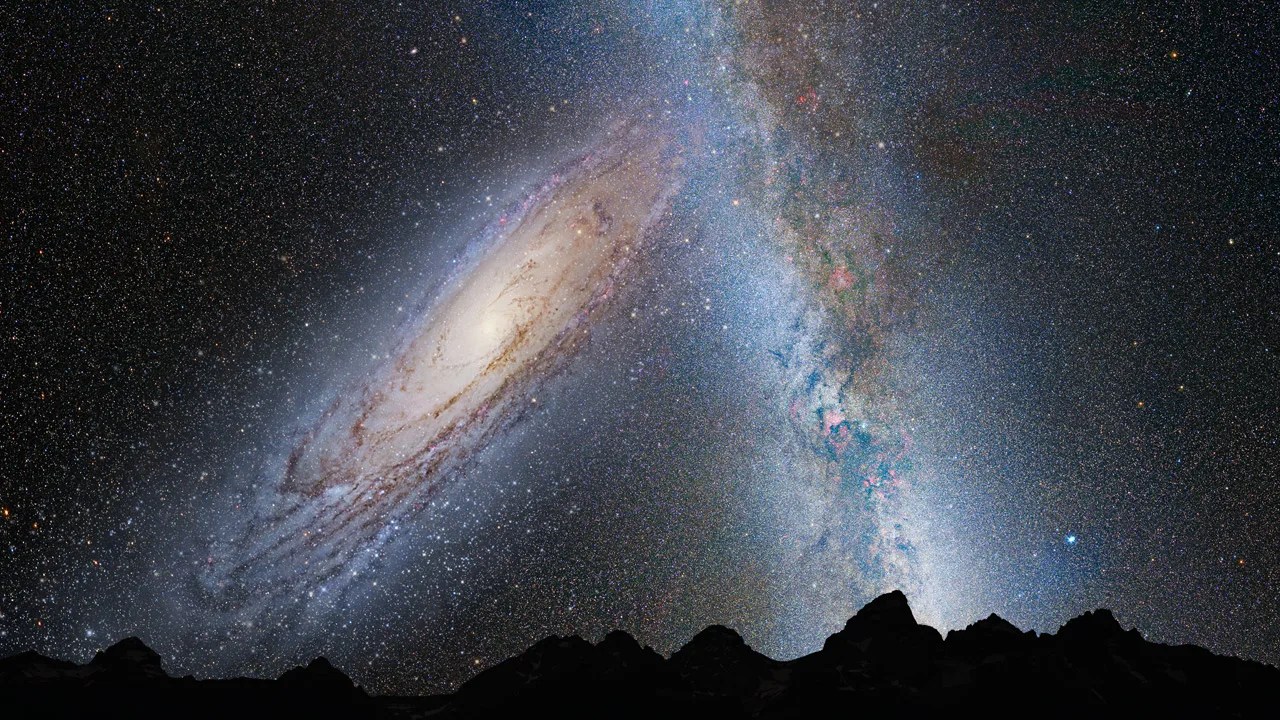
- Wikipedia also contains many pictures and a lot of background information on the upcoming Andromeda and Milky Way collision
- This article summarizes shortly the possible scenarios for our solar system as well. However, by that time all life will have disappeared already on planet Earth, as the sun’s luminosity will have increased by over 30% by that time, boiling and evaporating the oceans into oblivion.
Spiral galaxy renderer
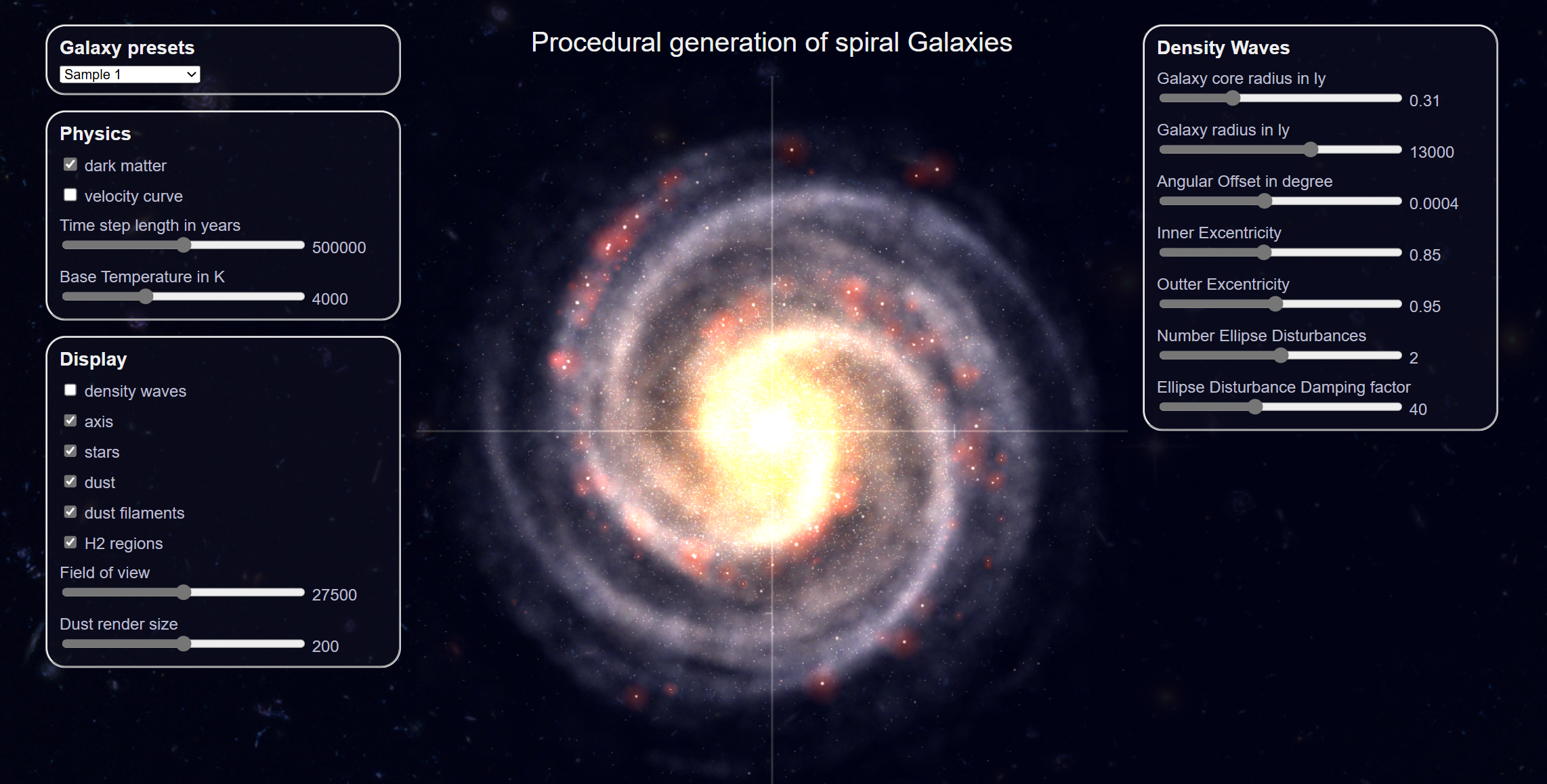
On this site, you can also find a live demo of a way more advanced 2D spiral galaxy simulator that is based on the density wave theory (on GitHub → Galaxy renderer). It is written by Ingo Berg in TypeScript. Click on the image below to activate this demo!
Share on: