Interactive simulations & visualizations
Visualizing the beauty in physics and mathematics
Project maintained by zhendrikse Hosted on GitHub Pages — Theme by mattgraham
Parametric surfaces
🔧 The images are generated with parametric_surfaces.js.
Numeric calculation mean & Gaussian curvature
We use central differences of second order for all derivatives as these derivatives are
- translation-invariant
- no preferred direction
- stable for curvature calculations
This is essential for:
- correct signs of k₁ and k₂
- correct ratio between both k₁ and k₂
Note that forward differencing is asymmetric and leads to an error in the curvature calculation.
For central differences we use:
\[X_{uu} = \frac{X(u+e)-2X(u)+X(u-e)}{e^2}\] \[X_{uv} = \frac{ X(u+e,v+e)-X(u+e,v-e)-X(u-e,v+e)+X(u-e,v-e)}{4e^2}\]Comparison with analytic Gaussian curvature of a torus
For a torus with major radius R and minor radius r we have the following parametrization:
⭐ The Gaussian curvature is given by:
\[K(v) = \frac{\cos v}{r (R + r \cos v)}\]👉 Note that this curvature
- is independent of u,
- is zero at $v = \pm\frac{\pi}{2}$,
- and has a change of sign between the blue ↔ red transition.
👉 For the coloring this means that:
-
🔴 Outside where $\theta = 0 \rightarrow \cos\theta = 1 \rightarrow K > 0$: elliptic, i.e. red
-
🔵 Inside where $\theta = \pi \rightarrow \cos\theta = -1 \rightarrow K < 0$: hyperbolic, i.e. blue
-
⚪ Side lines where $\theta = \pm \dfrac{\pi}{2} \rightarrow K = 0$: parabolic
👉 For the principal curvatures k₁ and k₂ we see that
-
$k_1$
- 🔴 Outside strongly positive (red)
- 🔵 Inside: strongly negative (blue)
-
$k_2$
- Everywhere the same sign
- Varying intensity
🧠 Summarizing, a torus has
- both positive and negative Gaussian curvature
- two closed K = 0-contours (the so-called “equatorial” circles)
- no contours where the mean curvature $H = 0$
Introduction to manifolds
From: Behold the Manifold, the Concept that Changed How Mathematicians View Space:
The term “manifold” comes from Riemann’s Mannigfaltigkeit, which is German for “variety” or “multiplicity.”
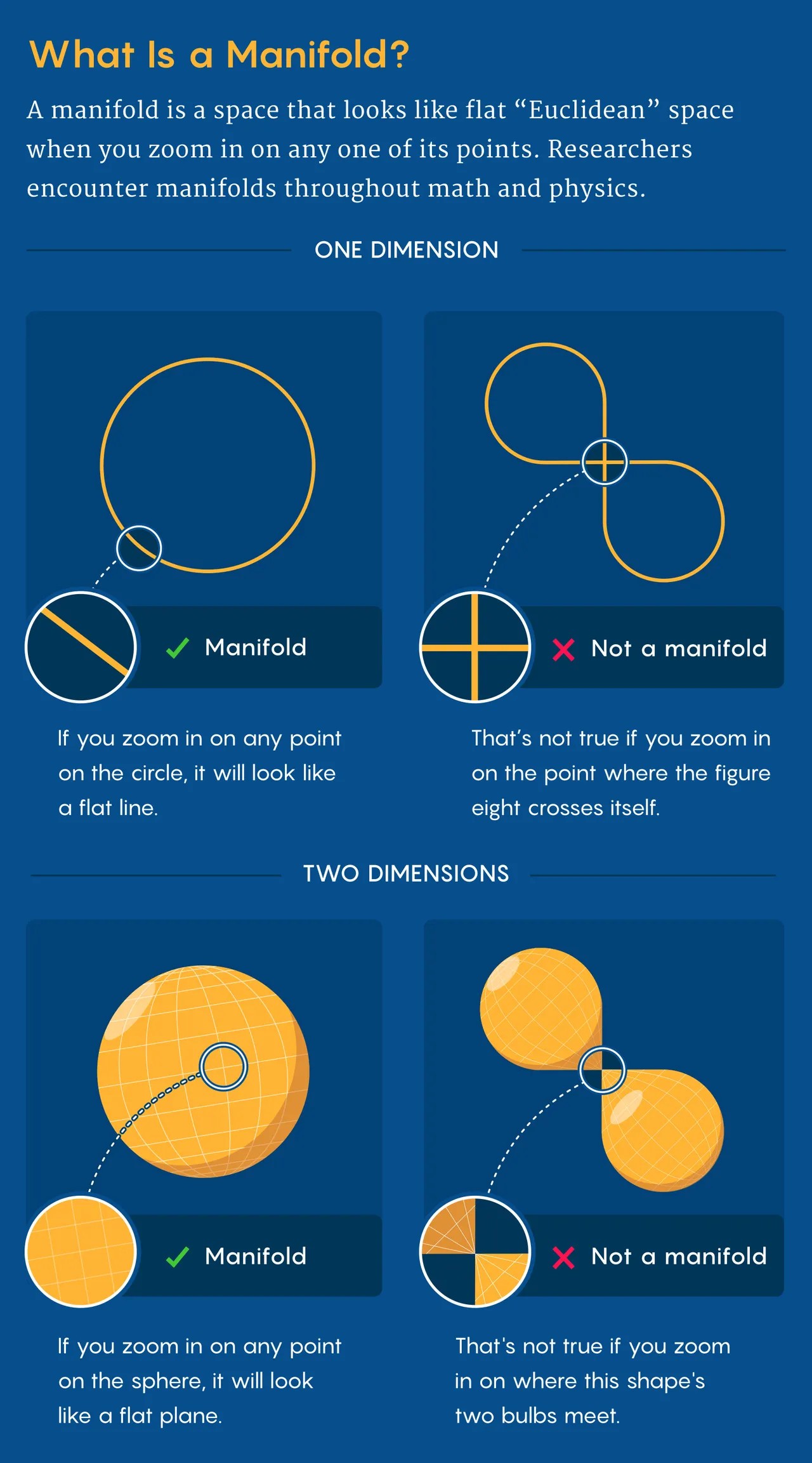
A manifold is a space that looks Euclidean when you zoom in on any one of its points. For instance, a circle is a one-dimensional manifold. Zoom in anywhere on it, and it will look like a straight line. An ant living on the circle will never know that it’s actually round. But zoom in on a figure eight, right at the point where it crosses itself, and it will never look like a straight line. The ant will realize at that intersection point that it’s not in a Euclidean space. A figure eight is therefore not a manifold.
Similarly, in two dimensions, the surface of the Earth is a manifold; zoom in far enough anywhere on it, and it’ll look like a flat 2D plane. But the surface of a double cone — a shape consisting of two cones connected at their tips — is not a manifold.
References
Share on: